


What is a garage door?
Garages consist of a sizeable door to the front. They are generally opened manually or with an electronic motor. There is sufficient space to accommodate most cars as well as many other types of vehicles. Smaller garage doors consist of one panel, which angles back and up across the garage roof in most cases.
Large garage doors will typically comprise of numerous jointed panels, rolling up on a track across the roof of the garage. Alternatively, they will form a roll directly above the entrance to the garage. To limit how much effort is needed from a motor or manually, the spring-loaded operating mechanism is counterbalanced against the weight of the door. Doors can be made from several materials, wood, metal or fiberglass, and to prevent heat loss there is the option to insulate them.


Up & Over Doors

Sectional Doors

Roller Doors

Remote Operated

Single Panel Garage Doors
One large solid panel is used to construct a single panel door. To fully open the door it must be push up and overhead on hinges located on both sides, known as jamb type hardware. When opening the door, the disadvantage is that part of the door protrudes outside of the garage. Any vehicle requiring access to a garage with jamb type hardware fitted must stop and park at a distance of several feet to avoid being hit by the door as it is opened.
Alternative single panel doors run on a single horizontal track, located on each side and fixed to the top frame. A roller is then mounted on each side at the very top of the door, with a hinges on either side, attached to the bottom. Using a one piece track type hardware means that you can park cars much closer to the door when it is opened, as the door lies fully inside of the garage door header.
Types of Garage Doors and materials
Steel has become the most common material for garage doors. A wide variety of sizes and styles are available now in modern steel and are able to provide strength and security, whilst being cost competitive. It is generally considered that 2 or 3 galvanised steel layers with a low gauge number gives greater strength for a garage door.
For aesthetic appeal, wood is an alternative although wooden garage doors may be more attractive they are also high-maintenance and expensive. Fibreglass and vinyl doors can match steel garage doors, and can imitate wood but are more expensive than steel. They combine a steel core behind a fibreglass or vinyl skin, they also have a polyurethane insulated base section, or other type of foam insulation. Aluminium is an inexpensive material that is light, rust-proof and low maintenance. The disadvantages of aluminium are its lack of strength which makes it more susceptible to dents.


Insulation and energy-efficiency
The insulation value and energy efficiency of a garage door is an important factor for many residential garages, to prevent overheating and freezing problems, and for energy savings.
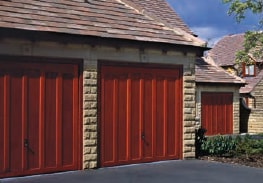
Steel stamped construction
A more cost-effective alternative for garage doors is steel stamped construction.
Steel sheets are formed to resemble a raised panel wooden door. These are currently available as insulated uninsulated and double skinned steel. A popular design is used to imitate carriage house doors, with many manufacturers cladding the steel door outer with composite or vinyl boards to give it the appearance of wood.
Torsion spring lift mechanism
Counterbalance torsion sprung systems entail of one or two springs, tightly coiled on a shaft with cable drums at either end. The complete device fits on the front wall, above the garage door with the aid of three supports. There is a centre bearing plate using a steel or sometimes a nylon bearing with 2 bearing plates at each end. The springs comprise of a winding cone at one end and the wire with a static cone at the opposite end. Connected to the centre bearing plate is the stationary cone. The winding cone has holes on it every 90 degrees for winding the springs and then two set screws securing the springs to the shaft. Running from the bottom corners, where the roller brackets are located on the doors to an indentation in the cable drums, are the steel counterbalance cables.
When raising the door, the springs will relax and unravel; the stored tension lifts the door by rotating the shaft, which ultimately turns the cable drums, resulting in the cables being wrapped around the grooves of the cable drum. The springs return to full tension when the door is lowered and the cables unwrap from the drum.


Extension spring lift mechanism
Parallel to the horizontal tracks there are a pair of stretched springs, this system is an extension spring lift mechanism. The door is lifted by the springs by pulleys and counterbalancing cables which run from the bottom corner bracket through the pulleys. The springs will contract and the tension is released which therefore lifts the door.

Maintenance
Regular checks as outlined in the manufacturer’s instructions need to be conducted, checking for correct operation, doing visual inspections of parts and lubricating the necessarily parts.
Safety
There are numerous ways garage doors can cause injure or damage property, as well as become damaged themselves. Falling doors are the most common injury arising from garage doors in addition to pinch points, incorrectly adjusted opener force settings, uncontrolled release of spring tension and safety eyes. Without the proper tools or knowledge do-it-yourself repairs have the potential to also cause injury.

A garage door can fall if it has a broken spring, or the wrong strength spring. To encourage “vertical orientation of the hand”, manually operated garage doors the handles should be fixed vertically.
A garage door accelerates quickly, due to the mass of the door increasing when the door transfers from the horizontal track to the vertical track. Motorised garage door openers have enough force when pushed or pulled open to injure or kill people and pets if they were to become trapped. Force settings on modern doors have been installed to reverse the doors action should it be confronted with too much resistance whilst opening or closing. Six inches from the ground is the maximum height for safety eyes to be installed.
Children should be kept away from a moving garage door at all times.
Injuries can occur if parts under tension are removed, such as springs, cables, bottom brackets and spring anchor plates
All garage door related property damage and injuries can be avoided by following these simple precautions.